

Every time I went to the rock field, I could always hear the voice of "don't step on the rope", and the teacher's repeated warnings made me deeply remember this "taboo" of the outdoor circle, and after that, every time I saw the rope hanging down on the ground, I would stand on tiptoe to avoid it carefully.

In fact, in the eyes of climbers, the climbing rope is "life", its importance is self-evident. Mountaineering, rock climbing, ice climbing, cave exploration, stream tracing and even rescue work, if the rope has problems, then it is likely to cause serious accidents.
Modern mountaineering rope is composed of "core" and "skin" two parts: the core fiber after heat treatment, it will become elastic and can be retracted, it is the "functional part" of the rope. "The rope skin mainly plays a protective role to prevent the core from being damaged by external friction.

Mountaineering ropes cannot be stepped on, dragged, or used as cushions, and are designed to prevent sharp objects, rock chips, and fine sand from getting inside the fibers of the rope and cutting it.
Climbing ropes can be categorized into static and power ropes based on ductility.
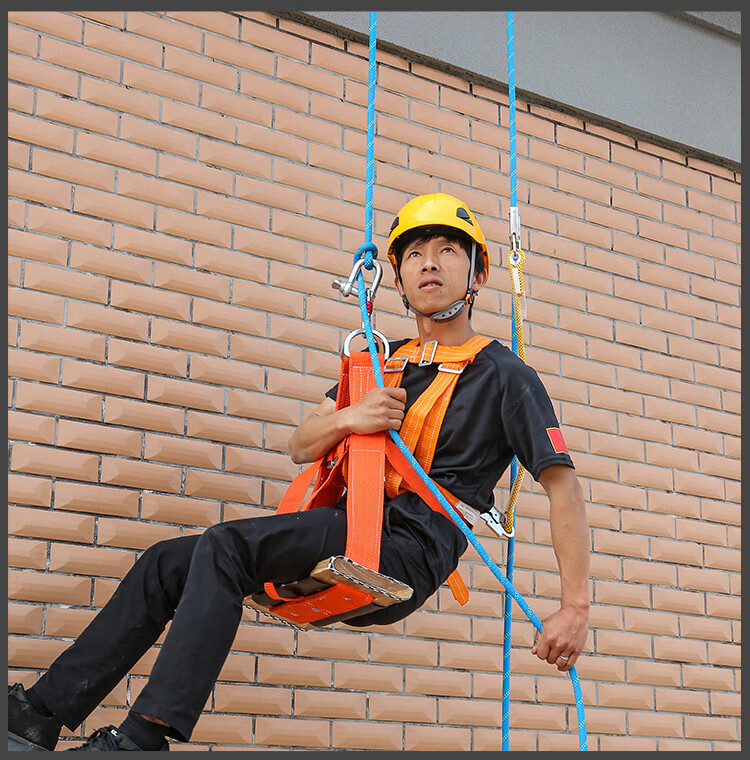
static ropes
Static ropes have little ductility, little or no lengthening in the event of a fall and absorb little impact, they are transferring all the impact forces directly to the protection system and to the person who has fallen, in which case even a very short ramming fall can have a very high impact on the system. Therefore static ropes are commonly used for vertical descents, SRT (Single Rope Ascent Technique), rescues and other activities where violent falls are unlikely to occur.
At the same time, static ropes are generally characterized by high temperature resistance, high strength, good toughness and tear resistance.
power ropes
Power ropes have high dynamic ductility, can be elongated under tension, can absorb impacts and have cushioning properties. Therefore, it is more widely used in rock climbing, ice climbing and other activities that have the risk of falling, because it can absorb the falling force that brings injuries to the climber through its own extension to cushion.
Of course, the ductility of the power rope can not be too high, usually less than 8%, otherwise it will be like bungee jumping, the climber in the fall after the up and down, very dangerous.

Care of climbing ropes
1. The things that the rope cannot touch are:
① Fire, strong ultraviolet rays;
② oil, alcohol, paint, paint solvents and acidic and alkaline chemicals;
③ Sharp objects.
2. When using the rope to use the rope bag, rope basket or tarpaulin pad under the rope, can not be stepped on, drag, or as a cushion, in order to prevent sharp objects cut fibers or rock chips, fine sand into the rope's fibers inside the slow cutting.

3. Try to avoid direct contact between the rope and water, ice and sharp objects. For example, if you are climbing in wet or icy places, you should use waterproof treated ropes; the rope should not go directly through bolts, fixing points, parachute belts and slings; when doing rappelling, it is best to wrap the part of the rope that comes into contact with the corner of the rock with a cloth or rope.
4. Check the rope after each use and coil the rope well. In order to avoid kinking of the rope, it is better to use the way of coiling the rope by dividing the rope into left and right sides and then folding up the bundle.

5. The rope to avoid frequent cleaning, cleaning should use cold water and professional cleaners (neutral cleaner), the purpose of washing the rope with cold water is to minimize the shrinkage of the rope. After cleaning (no residual cleaning agent) will be placed in a cool ventilated place to dry naturally, pay attention to the sun can not be sunshine, can not use the dryer, hair dryer, etc., these are on the rope inside a great deal of damage.
6. Timely record of the use of the rope, such as: the appearance of damage, to withstand how many falls and the circumstances of the fall, the use of the environment (rough or sharp terrain), whether or not they have been stepped on (this is particularly important in the backcountry and snow and ice climbing), ATC and other equipment, such as the surface of the wear and tear (these equipment will be the skin of the rope to cause damage).
As the "rope of life", every climbing rope is carefully selected, in addition to professional certification, but also according to the needs of the activity to choose the right rope. Remember to take good care of the rope when doing outdoor activities, in addition to better extend the life of the climbing rope, the most important thing is to be responsible for our lives!


